
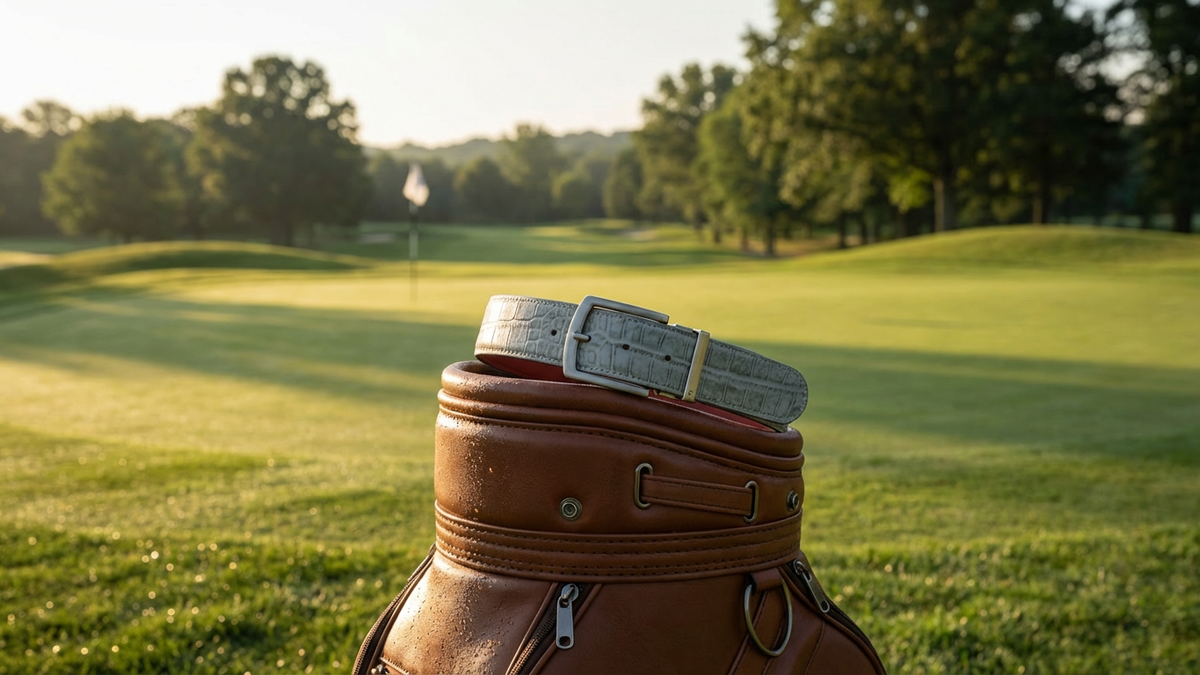
What You Have in Common with Scottie Scheffler (Hint: It's Not Your Swing)
Scottie Scheffler's $29 Million Season vs. Your 14 Lost Balls: A Tale of Two Golfers
Let's talk about Scottie Scheffler.
In 2025, the man won nine times on the PGA Tour. Nine. He made $29 million in on-course earnings alone—not counting the dump trucks of endorsement money backing into his driveway every other Tuesday. And that's before the $18 million FedEx Cup bonus he collected for basically being too good at golf. The man earned more money standing over four-foot putts than most of us will see in several lifetimes.
He has the most consistent swing in professional golf, the mental fortitude of a Buddhist monk who also happens to be a Navy SEAL, and a short game that makes grown men weep into their overpriced craft beers at the clubhouse.
Now let's talk about you.
Last Saturday, you showed up to your 9:42 tee time at 9:38, still chewing a gas station breakfast burrito that was definitely sitting under a heat lamp since the Clinton administration. You had one golf glove on and the other one was... somewhere. The trunk? The dog's mouth? Who knows. Time was a factor.
You hit your first drive into the parking lot. Not the parking lot of the course you were playing—the one next door. The Italian restaurant. A Fiat now has a dimple pattern on its hood that wasn't there before, and you're pretty sure the owner saw you shank it but you made eye contact and just kept walking like nothing happened.
By the turn, you'd lost four balls. Three of which were "still totally playable" according to your increasingly desperate optimism, and one of which is now legally the property of a retirement community. There's a 78-year-old man named Gerald who's going to find a Titleist Pro V1 with "DAVE'S BALL DO NOT TAKE" written on it in Sharpie, and he's absolutely going to take it.
You shot 47 on the front nine. You told yourself the back would be different.
It wasn't. It was worse. You lost ten more balls, bringing your total to fourteen, which is genuinely impressive in a way that should probably be studied by scientists. You found new and creative places to lose golf balls that the course architect never intended. You discovered water hazards that aren't on the scorecard. You hit a ball into a porta-potty. The door was closed.
Your final score looked like a modest home's street address.
The One Thing Every Golfer Controls: Getting Dressed
But here's the thing—and stay with me here because this is where it gets philosophical in a way that your gas station burrito didn't prepare you for.
Scottie Scheffler woke up this morning and got dressed. So did you.
He put on a shirt, pants, shoes, and a belt. You did too. Well, you put on a shirt that might have been clean and pants that definitely weren't, but the point stands. The difference isn't that he has access to some magical wardrobe portal that opens only for major champions. The difference is that he pays attention to the details—because when you're on camera at Augusta National with $3.6 million on the line, every detail matters.
Here's what most amateurs miss: you're on camera too.
Maybe not CBS. Jim Nantz isn't whispering about your "beautiful tempo" as you chunk a wedge shot into your own cart. But your buddy's Instagram story? That's live television now. Your wife's "candid" shot of you lining up a putt you're absolutely going to miss? That's going in the family group chat before the ball even lips out. The group photo at the turn where everyone's smiling except you because you just made triple bogey on a par 3 that a child could par? That's getting framed.
That's your broadcast. And brother, the footage isn't pretty.
I saw myself in a photo from last summer—mid-backswing, face contorted like I was being attacked by bees, wearing a belt that looked like it came free with a pair of pants I bought at a store that no longer exists. My buddy posted it with the caption "poetry in motion" and I genuinely considered unfriending him.
Why 400+ Tour Pros Choose DRUH (And You Should Too)
Let's be honest about what's fixable in your golf game and what isn't. I mean brutally, uncomfortably honest. The kind of honest that your playing partners are too polite to be.
Your swing? You've been working on it for 15 years. It's not getting better. That YouTube tip you watched about "shallowing the club" at 11 PM last Tuesday just made things worse. Now you're not only steep, you're steep AND you have some weird hip thing happening that looks like you're trying to start a lawnmower while dancing.
Your local pro is out of ideas. He's started suggesting you "just have fun out there" which is code for "I've given up on you as a project and I'd like to focus on the junior golfers who still have neuroplasticity."
Your swing is a feature now, not a bug. Accept it. Name it. I call mine "The Malfunction."
Your putting? Same story. You've tried the claw grip. You've tried the saw grip. You've tried the arm-lock, which made you look like a cyborg having a medical emergency. You tried something your college roommate called "the surrender," which involved essentially giving up and slapping at the ball with your eyes closed. Nothing works. The hole looks smaller every year, which is physically impossible but emotionally very real.
Your course management? You know you should hit 3-wood off that tight par 4 with water down the left side. You know it. Your caddie knows it (you don't have a caddie, but if you did, they would know it). The ghost of Ben Hogan knows it and is shaking his spectral head in disappointment.
And yet, there's the driver again. "I'm feeling it," you say, having not hit a fairway since Obama's first term. Hope springs eternal. The ball does not. The ball springs left, into the water, where it joins fourteen of its brothers from earlier in the round.
But your outfit? Your belt?
That's the one thing you can fix today. Right now. No lessons, no practice, no false hope, no YouTube videos from guys with 47 subscribers who claim they've "cracked the code."
Four hundred tour pros wear DRUH belts. They've played in major championships. They've represented countries in Ryder Cups and hoisted trophies on national television while wearing these exact accessories. Tommy Fleetwood, currently navigating life as an apparel free agent, has been spotted mixing and matching premium pieces—Sun Day Red hoodies, Johnnie-O polos, carefully selected belts that don't look like they came from the clearance bin at a defunct sporting goods store.
These guys could wear anything. They have literal teams of people whose job it is to dress them. And they choose this.
You'll never win the Masters. Let's just get that out of the way. You're not going to win the Masters. You're not going to win your club championship. You might win a closest-to-the-pin contest someday if nobody else shows up and the pin is placed next to where you were already going to miss.
But you can look like someone who lost in a playoff. And that's something.
The Psychology of Looking Good on the Course: Confidence as Armor
Here's something the pros understand that amateurs don't: looking good isn't vanity. It's armor.
When you step onto the first tee and you know you look sharp, something shifts. It's subtle. It's not going to fix your over-the-top move or your tendency to decelerate through chip shots like you're afraid of hurting the ball's feelings. But something shifts.
You stand a little taller. Your practice swing has a little more conviction—still bad, but confident. That first tee shot, the one you usually skull into the pro shop while a group of retirees watches in horror, has a slightly better chance of finding the short grass.
Will a great belt fix your slice? No. Obviously not. Let's not be ridiculous. A belt is not magic. If belts fixed slices, there would be no slices, and the golf instruction industry would collapse overnight.
But will it give you one small moment of confidence before the chaos begins? Will it make you feel like you belong on the first tee instead of someone who wandered in from the parking lot of the Italian restaurant next door where your ball currently resides?
Yeah. It might.
And in this game—this stupid, beautiful, impossible game that we've all somehow agreed to keep playing despite overwhelming evidence that we shouldn't—you take every edge you can get.
What's Actually Fixable in Your Golf Game (Spoiler: It's Your Belt)
The golf improvement industry wants you to believe that everything is fixable. New driver: 15 more yards. New irons: better accuracy. New putter: fewer three-putts. Training aids: finally break 90. Lessons: finally break 90. Online programs: finally break 90 (this time you mean it).
You've bought all of it. Your garage looks like a Golf Galaxy exploded. You have a launch monitor you don't know how to use. You have alignment sticks you've never actually aligned. You have a putting mat that your cat uses as a bed now.
And yet.
Here's what's actually fixable, ranked by likelihood of success:
- Your belt: 100% fixable. Buy a better one. Done. Problem solved. You look better. Takes 30 seconds.
- Your shirt being tucked in evenly: 95% fixable. Requires a mirror and basic motor function.
- Your attitude: 50% fixable. Requires therapy, possibly medication, definitely lowered expectations.
- Your course management: 15% fixable. You know what to do. You won't do it. Driver go boom.
- Your putting: 8% fixable. It's mostly mental at this point and your mental is not great.
- Your swing: 2% fixable. Accept it. This is who you are now.
The belt is the only guaranteed win on this list. Everything else is a gamble with odds worse than your chance of hitting the fairway on that tight par 4 (the one where you hit driver despite everything).
You're Bad at Golf—At Least Look Like You Belong
Scottie Scheffler made $29 million playing golf last year. You spent $47 at the turn on hot dogs and beer, then tipped the cart girl too much because you felt bad about your lie on 7. Not your lie as in the position of your ball. Your lie as in you told her you were "playing pretty well today" while standing at six-over through six holes.
He's the best in the world. He's so good that he won nine tournaments in a single season, which is genuinely absurd and historically significant. His Strokes Gained numbers look like typos. He's built different. He's playing a different game than you.
You're the best in your Thursday afternoon foursome, and that's only because Gary threw out his back loading his clubs into his trunk and Mike has been "working on something" with his swing for three months now that's made him significantly worse. The competition is not stiff.
But when it comes to getting dressed in the morning?
That's one place you can compete. That's one area where the playing field is actually level. Scottie Scheffler puts on a belt one leg at a time, just like you. Wait, that's pants. Belts don't work that way. The point is: you have access to the same quality. You can make the same choice to care about the details.
You can walk onto that first tee looking like someone who belongs there, even if the next four hours will provide overwhelming evidence to the contrary. You can have that one moment of quiet confidence before everything goes sideways.
Your swing is never going to be on TV. But your belt can be tour-quality.
You're bad at golf. At least look good.