
Golf YouTube Addict? You Can't Copy Their Swing, But You Can Copy Their Style
Let's be honest with ourselves for a minute.
You've watched every Bryson DeChambeau video this year. All of them. The 400-yard drives. The scientific breakdowns. That one where he plays with a random subscriber and makes it look effortless.
You've binged Good Good until the algorithm started recommending their videos before you even opened the app. You've let Rick Shiels "fix" your slice six different times. You've listened to 47 episodes of No Laying Up on your commute, nodding along like you understand what they mean by "controlling the low point."
You follow swing coaches on Instagram who post slow-motion videos with red lines, yellow circles, and arrows pointing at wrist angles you'll never replicate.
You have consumed more golf instruction content than actual tour players.
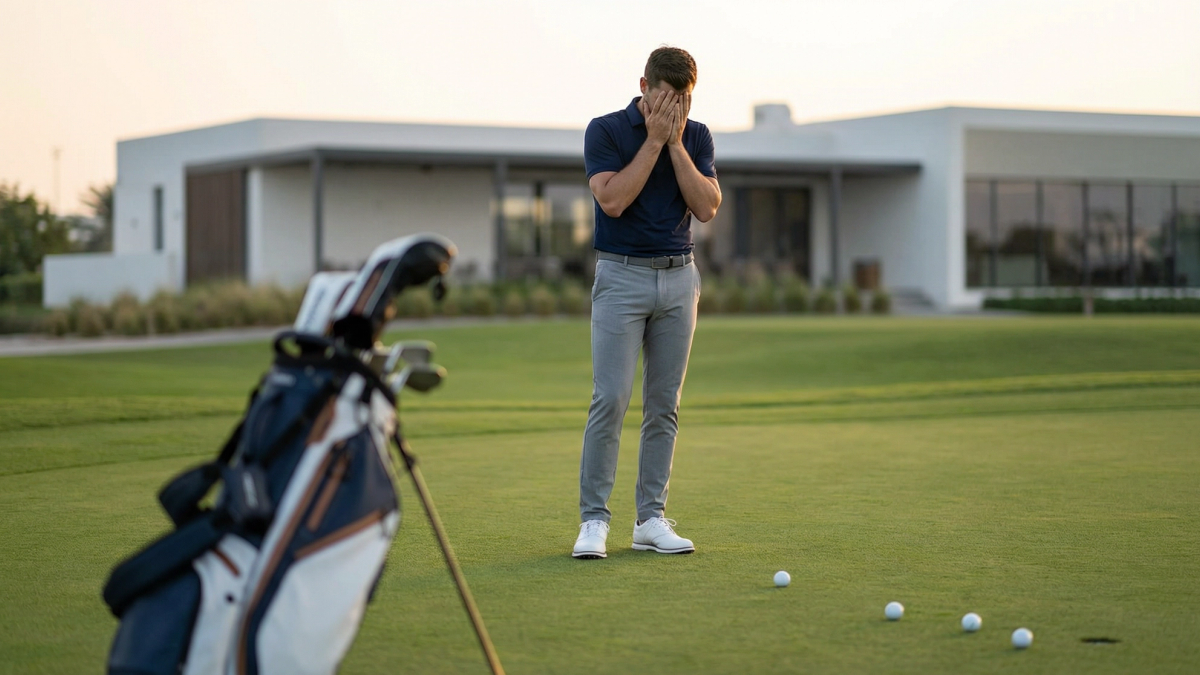
You shot 104 last weekend.
Welcome to the club. There are millions of us.
The 2am Rabbit Hole: A Golf Content Consumption Confession
It always starts innocently. You topped a 7-iron on the 14th hole. Embarrassing. Unacceptable. So you grab your phone that night, type "how to stop topping irons," and suddenly it's 2:17am and you're watching a video titled "The One Move That Changed EVERYTHING About My Ball Striking" from a guy with 847 subscribers.
You've been down this road before. Many times.
The YouTube rabbit hole is real, and golf content creators have perfected the art of keeping you there. One video on fixing your slice leads to a video on swing plane. Swing plane leads to grip pressure. Grip pressure leads to a 45-minute breakdown of Ben Hogan's Five Lessons. And somehow you end up watching a guy explain why your left pinky toe position is destroying your transition.
By 3am, you're convinced you've cracked the code. You've got it figured out. Tomorrow at the range, everything changes.
Tomorrow at the range, you shank your first three balls and wonder if you should take up pickleball.
Your YouTube Algorithm Thinks You're a +2 (You're Actually a 24)
Here's the thing about consuming this much golf content: your algorithm has no idea you're terrible.
Your YouTube homepage looks like you're preparing for Q-School. TrackMan analysis videos. Putting stroke breakdowns. Deep dives into optimal launch angles and spin rates. Your recommended feed is indistinguishable from what Scottie Scheffler might see.
But let's look at the numbers. According to the latest handicap statistics, the average male golfer in the United States carries a 14.2 handicap index. The average female golfer sits at 27.5. And those are just the golfers who actually track their handicaps—which means they're probably more serious than most.
If you play fewer than 10 rounds a year? The average handicap jumps to 18.7 for men. Casual golfers, in other words, are not getting better by watching videos. They're getting better at talking about getting better.
Meanwhile, the YouTube golfers you're watching? Brad Dalke from Good Good plays to a +6.2. Bryson DeChambeau carries a +9.9. Even the random club champion who shows up in Rick Shiels videos probably plays to scratch or better.
You're watching plus handicaps and expecting those lessons to translate to your 24. It's like watching Formula 1 to improve your commute.
The Knowledge-to-Execution Gap: Why 400 Hours of Content Won't Fix Your Slice
You could write a dissertation on swing plane at this point. Seriously. You know more about TrackMan numbers than most club pros. You have opinions—strong ones—about wrist conditions at the top of the backswing. You've explained smash factor to your wife, who absolutely did not ask.
And yet.
The ball still goes sideways. The 4-footer still lips out. The knowledge hasn't transferred.
It never does. Not really. Not from watching, anyway.
Here's why: a professional golf swing generates muscle activity reaching 90% of maximal voluntary contraction for amateurs. Tour players actually use less—around 80%—because they're more efficient. But the physical demand is real, and it requires thousands of hours of doing, not watching.
You can't absorb a swing through your eyeballs. Your body doesn't learn that way. Watching Bryson hit bombs is entertainment, not instruction. Your nervous system doesn't care how many YouTube videos you've consumed. It only knows what you've actually practiced.
You bought the same driver as Bryson. You're still slicing.
The equipment didn't help. The videos didn't help. The podcast episodes about course management definitely didn't help when you aimed at the right edge and pulled it into the left bunker anyway.
But here's the thing—while you were watching all those videos, you noticed something else. Something that doesn't require a +6 handicap to replicate.
Those guys look sharp.
What You Actually Noticed Between Swing Tips: These Guys Look Sharp
Between the slow-motion breakdowns and the launch monitor readouts, something caught your eye. Bryson's belt game is tight. The Good Good boys are coordinated head to toe. Even the random member who gets paired with Rick Shiels in those "I played a subscriber" videos looks put together.
This isn't an accident.
Professional and semi-professional golfers understand something that weekend hackers often miss: presentation matters. Not because it affects your swing (it doesn't), but because it affects how you carry yourself. How you feel on the first tee. How you walk up to your ball after a bad shot.
Looking like you belong is its own kind of confidence. And confidence, unlike swing mechanics, doesn't require 10,000 hours of practice.
You can't copy their swings. But you can copy their style.
The One Thing You CAN Take From Bryson and Good Good: Belt Game
Pay attention next time you're watching your favorite golf content. Look at the details. Not the clubhead speed or the spin numbers—look at what they're wearing.
Bryson's outfits are coordinated. His belt matches his shoes. His hat works with his shirt. It's intentional, and it reads as polished even when he's bombing drives into another dimension.
The Good Good crew has built entire identities around their on-course aesthetics. Matching colors. Clean lines. Belts that pop without screaming for attention.
This is the secret hiding in plain sight: the thing that separates someone who looks like they shoot 74 from someone who looks like they shoot 104 isn't their swing. It's their outfit. It's the belt that pulls everything together. It's the small details that signal you take this seriously.
You might not be able to control your ball flight. But you can control whether your belt matches your shoes. You can show up looking like you belong on a course, even if your scorecard says otherwise.
And here's the beautiful part: unlike swing changes, which take months to groove and often make things worse before they get better, upgrading your look works immediately. You put on a proper belt, and you look better. Done. No range sessions required.
Dress Like Someone Who Could Break 100 (Even If You Can't Yet)
So let's talk about what you can actually take from all those hours of golf content.
Your YouTube education wasn't a complete waste. You learned what good looks like—not just in terms of ball striking, but in terms of presentation. You've seen what a put-together golfer looks like. You've noticed the details, even if you didn't realize you were noticing them.
Now use that.
Start with the belt. It's the anchor of any golf outfit, the piece that ties your shirt to your pants to your shoes. A cheap belt—or worse, no belt at all—is like wearing a fitted polo with cargo shorts. It undercuts everything.
A proper golf belt does three things: it fits right (no extra tail hanging past the loop), it complements your outfit without trying too hard, and it's built to last through 18 holes of movement without losing its shape.
The Good Good boys understand this. Bryson understands this. The club champion in your Saturday morning group who always looks sharp? He definitely understands this.
You don't need to shoot their scores to dress like them. That's the whole point. Style is the one area of golf where you can compete with anyone, regardless of handicap.
Look, your golf game might be a work in progress. Join the club—the average handicap hasn't budged much in decades despite all the technology, instruction, and content available to us. We're all out here grinding, watching videos at midnight, hoping the next tip will be the one that finally clicks.
Maybe it will. Maybe this year you'll finally break 100, then 90, then start dreaming about 80.
But in the meantime, you can show up looking like someone who could. You can walk onto the first tee with the confidence that comes from knowing your outfit is dialed. You can look like a player, even if you're still figuring out how to be one.
You've spent 400 hours learning what good golfers look like. Now it's time to actually look like one.
Your slice isn't going anywhere. But your style? That you can fix tonight.