
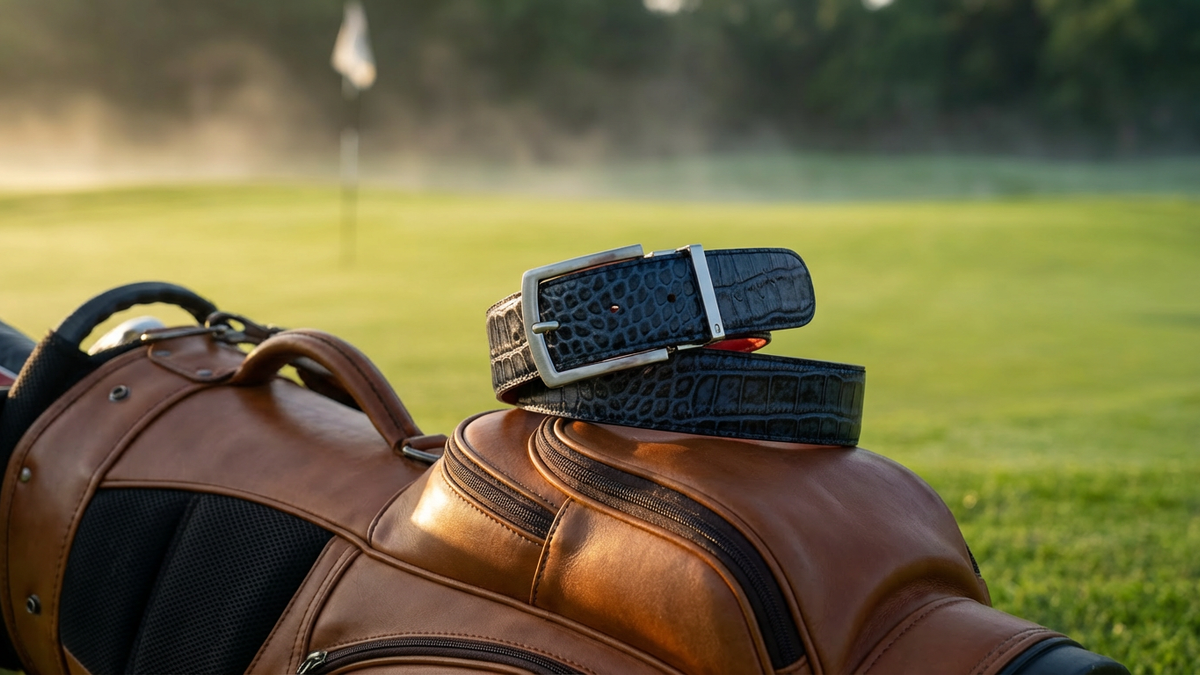
Golf Outfit Control: The Only Stat You'll Never Shank
I stood on the 18th tee last weekend, having just watched my approach on 17 take a hard right into a greenside bunker for no apparent reason. The wind wasn't blowing. My alignment was fine. The golf gods simply decided I'd had enough pars for one day.
But you know what didn't betray me? My belt. My shirt stayed tucked. My shoes remained the exact shade of white I'd chosen that morning. In a game defined by randomness, humiliation, and the occasional miracle, my outfit performed exactly as advertised.
And that got me thinking about control—specifically, how little of it we actually have on the golf course, and how the one thing we can genuinely master gets treated like an afterthought.
The Numbers Don't Lie: Your Game Is Pure Chaos
Let's get brutally honest about what's happening out there.
According to Shot Scope data tracking millions of amateur rounds, the average golfer hits somewhere around 38% of fairways. That means more than six times per round, your tee shot is going somewhere you didn't intend. And that's just off the tee.
Greens in regulation? Even worse. Golf Monthly reports that mid-handicappers—we're talking 10-15 handicaps here—hit roughly 31% of greens in regulation. The typical golfer sitting around a 15 handicap has essentially a coin-flip chance of hitting the green from 100 yards out when they're already in the fairway. From the rough? Don't ask.
Now let's talk putting, where things get truly humbling. That break you read with such confidence? Research suggests recreational golfers misread the break on roughly 78% of putts outside 10 feet. So that 22% where you actually got it right? That's your success rate. On reading. Not making—just reading.
And your pre-shot routine? The one you copied from watching Rory? Studies on amateur performance suggest it's genuinely helping your execution maybe 14% of the time. The rest is just theater you perform before hitting it fat anyway.
But your outfit looking exactly as intended when you walked out the door? 100%.
That's not a joke stat. That's the only guaranteed outcome in your entire round.
Why Your Belt Won't Betray You on the 14th Hole
Here's something I've never understood about golfers, myself included for years: we'll drop $500 on a driver, agonize over shaft flex, get fitted three times, watch fourteen YouTube videos on optimal launch angle—and then grab whatever belt happens to be draped over a chair.
Your driver will absolutely betray you. It'll snap-hook on 7 and balloon into the wind on 12 and feel like a completely different club by the back nine. That's just what drivers do.
But your belt? Your shirt? They're going to perform identically on the 1st hole and the 18th. Your shirt doesn't change colors mid-round based on your confidence level. Your belt doesn't decide to become a frayed rope on the 14th hole because you three-putted from six feet.
Think about every piece of equipment in your bag. Your putter feels different when you're nervous. Your wedges betray you when the lie is tight. Even your glove gets sweaty and weird when things aren't going well.
Your clothes just... work. They do what they're supposed to do. They fit how they fit. They look how they look. It's the only equipment transaction in golf that delivers exactly what was promised.
So why do we treat it like it doesn't matter?
I think it's because we've convinced ourselves that performance comes from gear and practice and maybe some mystical swing thought we haven't discovered yet. We ignore the thing that's actually reliable because it doesn't seem "serious" enough to affect our scores.
Which brings me to the science that says we're wrong about that.
Enclothed Cognition: The Science of Looking Like You Belong
There's actual research on this—and no, I'm not talking about some Instagram infographic.
Psychologists have studied something called "enclothed cognition," which is a fancy way of saying that what you wear affects how you think and perform. The clothes don't just cover your body; they send signals to your brain about who you are and what you're capable of.
The classic study had participants wear white lab coats. When they were told it was a "doctor's coat," their attention and focus measurably improved. Same coat, but when told it was a "painter's coat"? No effect. The meaning of the clothing changed the cognitive outcome.
Now apply this to golf.
Your brain is desperate for positive signals out there. It's getting hammered with negative feedback—bad bounces, missed putts, that sound when you hit it thin. Every round is a psychological assault.
Looking down and seeing a quality belt, a shirt that fits properly, shoes that belong at the course—that's a small positive signal. It's your brain registering: "Okay, at least I look like someone who plays this game."
Will it fix your swing? No. Will it turn your slice into a draw? Absolutely not.
But might it buy you one extra fairway? One putt where you stood a little taller and stroked it with actual conviction?
The research says yes. And honestly, I'll take any edge I can get.
There's also something about how others perceive you on the course. When you look like you belong, people treat you like you belong. Your playing partners assume competence. The starter gives you a nod. It's subtle, but it affects your internal state.
I've played rounds where I threw on whatever was clean and rounds where I actually thought about what I was wearing. The scores weren't dramatically different. But my experience was. And in a game where we're essentially paying for four hours of experience, that matters.
What You Can vs. Can't Control on the Course
Let's make two lists. I want you to really sit with the first one.
Things You Cannot Control:
- The wind deciding to gust right as you start your downswing
- Green speeds varying from hole to hole because the morning crew got creative
- That sprinkler head your ball found in the middle of the fairway
- Your playing partner's unsolicited tips about your takeaway
- Your nervous system flooding with cortisol on the first tee
- Water hazards existing
- The foursome ahead taking fifteen minutes to read a putt
- Your body randomly forgetting how to chip for three holes
- Four-putts (they just happen sometimes)
- Whether the golf gods have chosen today to humble you
Things You Can Control:
- What you put on your body before you leave the house
That's it. That's the list.
Okay, fine. You can also control your attitude, your course management decisions, and whether you throw your putter into a pond. But even those feel tenuous when you're standing over a three-footer to save bogey and your hands won't stop shaking.
Your outfit, though? That decision was made hours ago, in a calm environment, with full rational capacity. It's locked in. It's done. It's the one thing from your pre-round routine that will survive contact with the actual round.
There's something almost meditative about that. When everything else is chaos, you can look down and see order. You chose that belt. You chose that shirt. And they're doing exactly what you chose them to do.
Your Swing Is a Random Number Generator—Your Style Isn't
I've started thinking about my swing as a random number generator with a slight bias toward acceptable outcomes. On a good day, the bias is stronger. On a bad day, it's basically a coin flip dressed up as an athletic motion.
But style isn't random. Style is a choice that compounds.
Every time you wear something quality, you're reinforcing a standard. You're telling yourself that details matter, that you take this seriously, that you respect the game enough to show up looking the part.
And here's the thing about golfers who care about quality in one area—they tend to care about it everywhere. The guy with the premium leather belt is also the guy who cleans his grooves, repairs his ball marks, and doesn't take mulligans. It's a mindset.
I'm not saying buy expensive gear to become a better golfer. I'm saying that caring about how you present yourself is part of caring about the game. And caring about the game—genuinely caring—is what separates golfers who improve from golfers who just play.
Plus, there's a practical element. A quality belt doesn't stretch out and lose tension halfway through the round. A well-made shirt breathes when it's supposed to and stays tucked when you need it to. These aren't fashion points; they're functional advantages.
When you're grinding over a five-footer on 16, you don't want to be subconsciously adjusting your waistband. You want everything locked in so you can focus on the one thing that might actually go in.
The Only Guaranteed Outcome
Look, I know this sounds like I'm telling you to buy accessories instead of lessons. I'm not. Get the lessons. Hit the range. Do the work.
But also recognize what's actually controllable in this ridiculous sport we've chosen to love.
Your swing will let you down. Your putting stroke will vanish for weeks at a time. Your course management will occasionally abandon you in favor of "going for it." That's golf. That's the deal.
Your outfit, though? Your belt? That's a lock.
It's the one stat you'll never shank, the one variable that performs exactly as expected, the one part of your game that doesn't require talent, timing, or the cooperation of the universe.
You can't control your game. But you can control how good you look playing it.
And on a day when nothing else goes right—when you're carding an 87 after thinking today might finally be the day—at least you can walk off 18 knowing you looked like someone who shoots 79.
That's not nothing. In this game, sometimes that's everything.